

With the collapse of the highrise condo market in the Greater Toronto Area and other major Ontario cities, designers and developers have turned to alternative markets to stabilize their balance sheets.
Toronto’s RAW Design Inc. has pivoted to smaller-scale density developments, often featuring affordable rental options in communities such as Peterborough, Brockville, Whitby and bigger cities like Hamilton and even suburban Ottawa.
“We’re always trying to get our buildings to fit the context they are in, but that is always a trick when you are bumping up the density, height or volume of a building onsite,� says Roland Rom Colthoff, design director, RAW Design.
Moreover, with affordable housing so scarce, finding ways of cutting the costs of mortar and bricks is paramount.
One of the best budget-tightening ways is to eliminate underground parking.
“No one can afford to build underground parking,� says Colthoff. “We look for ways to integrate the cars into the overall mass of the building so they don’t dominate the street and they don’t take up the site.�
Design solutions include parking partially below grade or above grade but encapsulated within the building form.
“It’s quite involved…like a Chinese puzzle to figure out how you can fit the car into the form of the building to provide access for residents but still have a compact building form.�
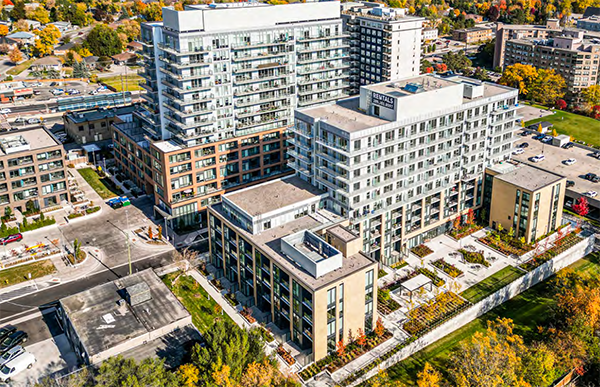
For an award-winning 12-storey affordable rental building in Newmarket the architect created a four-level above-grade parkade with cladding. The parkade was sited with three sides hidden by the residence from the street and it features a shared courtyard on its roof.
While integrating parking onto a site in new ways is one challenge, another can be convincing the developer that an unconventional parking design is the best approach, he says.
Other cost-cutting elements include reducing or eliminating common areas and corridors in smaller projects.
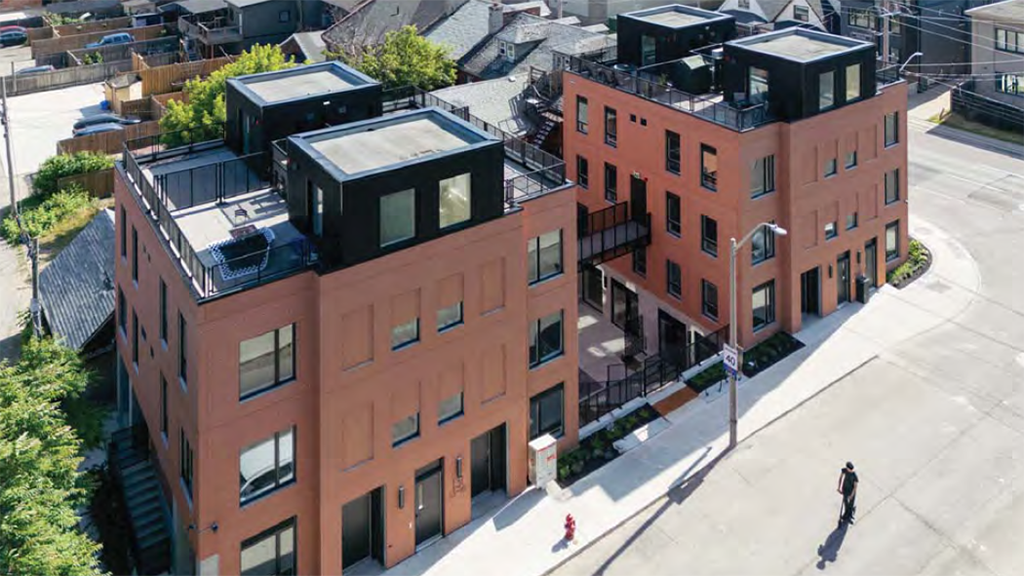
RAW Design took a novel approach to the design of a Hamilton complex featuring two four-storey rentals by incorporating a catwalk bridge connecting the buildings at the third floor. It eliminated the need for a costly full set of stairs in each building, says Colthoff.
The four-storey buildings are further unified by a sunken courtyard that provides residents access to basement units without going through corridors.
“It became quite an efficient layout and also created a lovely sunken courtyard that residents can share.�
The project received an Urban Design Award of Merit last year from the City of Hamilton.
“Although a unique design, we feel it has some features/lessons we will be able to use in future work,� the architect points out.
To keep costs down on a traditional stacked townhouse complex under construction in Hamilton, RAW pulled the garage partially above grade, covered it up and built residences above it.
“It’s interesting because it is for a private affordable rental housing provider.�
In an east-end suburban single-family home area of Ottawa, the firm designed a nine-storey building with a U-shaped internal shared amenity courtyard and a ramp-down below-grade parkade hidden from the street.
In Kingston, a six-storey residence in a low-density neighbourhood has parking tucked into the building’s rear, nestled partially underground.
Colthoff says municipalities understand the urgency of adding residential density so they are more receptive to design approaches that fall outside traditional development norms.
In the GTA, highrise condo developers are turning their projects into rentals, without upsizing the units they had planned because as smaller rentals they are more affordable.
The architect adds the residential market is much more competitive than in the boom.
“You have to come up with something unique to market and you have to deal with all these real issues of how you are going to pay for all this common area…underground parking,� he says.
“This is a good time to get it (design) right because there is no rush. There’s no point in trying to run out 500 units in a tower but 100 to 150 units in lower midrise development is achievable and is a typically more humane scale of development.�
Recent Comments
comments for this post are closed