

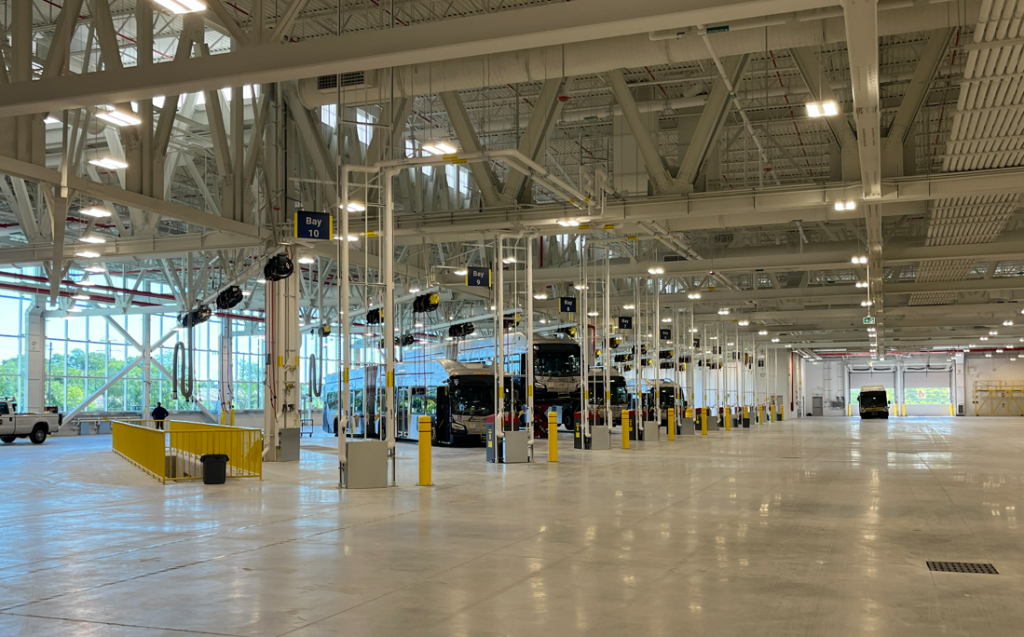
The recently completed $390.4 million Birch Transit Centre is designed to support Hamilton’s existing compressed natural gas (CNG) public bus fleet — the largest in Ontario — while incorporating structural, spatial and electrical provisions for a future transition to battery‑electric buses.
On a 24-acre property, the 420,000-square-foot building constructed by general contractor Pomerleau Inc. over about three years includes indoor bus storage, two CNG fuelling lanes, 30 maintenance bays, two bus washing systems and administrative space.
CNG has been central to Hamilton’s bus system (Hamilton Street Railway) for decades and it is the major fuel used by the fleet today.
But the transit centre is unusual because it “marries” that technology with space in the facility for the addition of battery electric propulsion when the need arises, says Eric Czerniak, principal and market sector lead, operations and maintenance facilities at Arcadis, the project’s lead designer and operations and maintenance facilities sector lead.
The facility posed a number of challenges for Arcadis and the rest of the building/design team.
To meet CNG code requirements, the transit centre incorporates methane gas detection, automated logic controls and an integrated BAS that manages ventilation, alarms and emergency shutdown functions.
During the masterplan stage, the team went through several design iterations to arrive at a practical solution for the CNG fleet and a future electric-powered fleet, Czerniak says.
“It was like trying to put a jigsaw puzzle together to arrive at a layout that met the stakeholder requirements.”
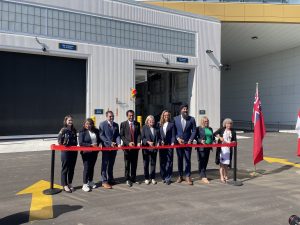
Provisions designed for future charging infrastructure include structural integrity for roof-mounted pantograph systems, heavier electric-bus loads and a future indoor battery-electric-bus substation.
“Hamilton has proven there is room in Canada for a CNG-fleet as a lower emissions alternative while at the same time it is planning for future zero-emission vehicles, should they become more affordable, perhaps with better mileage,” he says.
The Birch Transit Centre is a concrete and steel structure with long-span trusses for column-free garage space. It is designed to meet many of the principles of LEED Silver, which include energy efficiencies and water conservation. The roof structure was engineered to support future solar panels.
Czerniak says one of the main reasons the project took several years to deliver is the extensive pre-enabling works. The site required additional lands, buildings to demolish and tenants to relocate and it had soils contaminated with old foundations and abandoned steel.
To increase the bearing capacity of the soil without bringing in new costly soil involved such improvement means as rammed aggregate piers and small-diameter anchors drilled deep into the soil.
“We had our fair share of surprises…getting out of the ground was somewhat tricky.”
Czerniak says he has been working on the transit maintenance facility for about nine years. While that might seem lengthy, he says for a project of its size and complexity, it is within industry norms.
“Perhaps if you eliminate unforeseen funding delays you might be able to shorten the development cycle to seven years.”
The tri-government financing includes $142.8 million from the federal government, $92.6 million from Ontario and $155 million from the City of Hamilton. The facility was completed on budget, says Czerniak.






Recent Comments
comments for this post are closed