

Construction has taken flight on a sprawling new De Havilland Aircraft of Canada manufacturing and aviation hub in Wheatland County, Alta., that promises to create thousands of jobs.
The project, known as De Havilland FieldStatusDesignValue$200MLocationTrans-Canada Hwy, Gleichen ABSectorPrivateTypeIndustrial · New ConstructionData as of July 16, 2026, will also strengthen Canada’s ability to design, build and support aircraft at home.
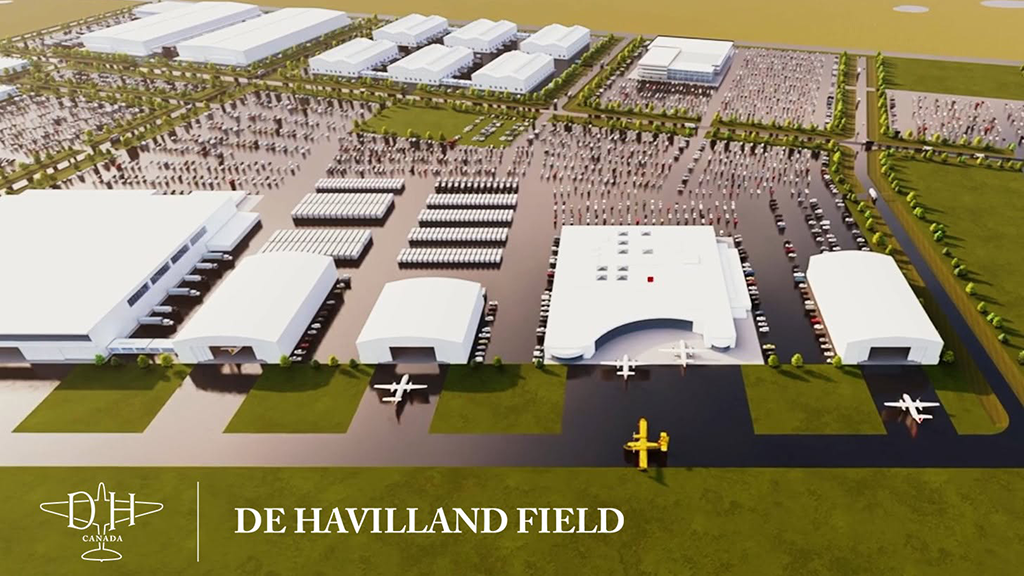
The development will be a purpose-built aerospace manufacturing complex built on approximately 1,559 acres of farmland west of Strathmore and roughly 30 minutes east of Calgary.
It will serve as the company’s new home and production centre and be one of the most significant investments in Canadian aerospace infrastructure in several decades.
De Havilland officially broke ground on the development in May, marking the start of a long-term development that will be rolled out in three phases.
It will be “a true greenfield site where the next generation of aerospace innovation can take shape without limits, a place where the possibilities are as open as the prairie sky,â€� says De Havilland.
Each stage of the development is designed to expand the company’s capabilities while creating a fully integrated aerospace campus.
The first phase is focused on supporting the immediate growth and production needs of De Havilland, and will include aircraft parts manufacturing, aerostructures production and a global distribution and logistics hub that will support customers around the world.
Future expansion is planned through phases two and three to significantly broaden Canada’s aerospace manufacturing capacity. Those stages will add final aircraft assembly, testing and certification facilities, along with a dedicated runway that will allow completed aircraft to be flown directly from the site.
Once complete, the company envisions De Havilland Field as “a fully integrated campusâ€� where production, innovation and progress come together.
Plans submitted to the Impact Assessment Agency of Canada (IAAC) outline an aerodrome on the southern portion of the property, with commercial and industrial development occupying the northern and eastern sections.
Beyond manufacturing facilities, the campus will include corporate offices, logistics operations, maintenance and repair services, customer support facilities and aircraft delivery infrastructure.
The location of the De Havilland Field project is ideal, the company says, as it has access to a large, young and diverse labour pool, family-friendly cost of living and access to major transportation routes such as Highway 1 and a world-class international airport for parts distribution.
Portions of the site are already designated as suitable for commercial and industrial development.
The first building at De Havilland Field is expected to open in the spring of 2028.
According to project documents filed with the IAAC, the facility is needed to meet growing global demand for De Havilland’s three aircraft platforms: the DHC-515 Firefighter, the DHC-6 Twin Otter and the Dash 8.
The new facility is expected to play an important role in fulfilling the company’s $1.6-billion contract to build 24 DHC-515 Firefighter aircraft for six European Union countries, while also creating opportunities to supply additional firefighting aircraft to Canadian jurisdictions and international customers.
The project will allow the company to assemble all three aircraft in one location while consolidating manufacturing, maintenance, logistics and support services on a single campus.
The location was also chosen because of its proximity to Highway 1, nearby Calgary International Airport and land already designated for commercial and industrial development.
During construction and once operational, De Havilland Field will create thousands of jobs in trades, engineering, manufacturing and aviation services.
The Alberta government estimates the completed development will support approximately 3,000 permanent operational jobs, while attracting suppliers, aerospace companies and technology partners to the surrounding region.
De Havilland says the investment will anchor a broader aerospace ecosystem by encouraging additional businesses to establish operations nearby, creating long-term economic activity and strengthening Canada’s domestic supply chain.
In a statement, De Havilland Canada CEO Brian Chafe said the project is about much more than constructing a new manufacturing facility.
“It is about building sovereign capability in Canadian aerospace, manufacturing, service support, and training. The potential of De Havilland Field is massive.�
He noted De Havilland is entirely Canadian-owned and relies on an 80 per cent Canadian-based supply chain, adding government support for domestic aerospace manufacturing could unlock even greater opportunities.
The project also aligns with the federal government’s Defence Industrial Strategy by strengthening Canada’s sovereign aerospace capability and reducing reliance on foreign manufacturing.
De Havilland says investing in domestic infrastructure will help ensure Canadian aircraft continue to be designed, built and supported by Canadian workers while reinforcing the country’s position in specialized aircraft manufacturing.
The company has a fleet of more than 5,000 aircraft delivered to operators worldwide. They are trusted for a wide range of missions, including aerial firefighting, search and rescue, medical evacuation, and surveillance.




Recent Comments
comments for this post are closed