

In this six-part Journal of Commerce feature series, BC 1 Call examines one of the few industries where success is measured by what doesn’t happen. Its greatest achievements rarely make the news, while a single, avoidable mistake can bring everyday life to an abrupt halt. Part one took a look at building the future around our past. Part two illustrated how critical infrastructure investments must also carefully consider what’s below the ground. Part three examines a utility strike and the ripple effect.
A utility strike is rarely a single event. It is the beginning of a cascade of consequences — some inconvenient, others life changing.
On July 24, 2007, a 30-metre geyser released nearly 234,000 litres of crude oil for almost 25 minutes on Barnett Highway in Burnaby. It coated everything in its path, spilling through neighbourhood streets and into storm drains that emptied into the Burrard Inlet. Homes were contaminated and residents were forced from their neighbourhoods, as one of B.C.’s most significant environmental responses ever associated with an excavation incident got underway. What followed were months of environmental remediation, shoreline restoration and community recovery.
More recently, investigators examining Calgary’s Bearspaw South Feeder Main failure concluded several factors contributed to the catastrophic rupture, including evidence of previous damage to the main. Unreported contact with buried infrastructure — regardless of how inconsequential it may initially appear — can gradually reduce the integrity of that system. Not every excavation strike announces itself dramatically, but eventual consequences can still be catastrophic.
BC Hydro recently had an incident in downtown Vancouver where an excavation contractor drilled into a duct bank and damaged multiple high-voltage electrical distribution cables.
One of the cables faulted, leading to a widespread power outage for customers that included homes, hospitals, schools and government offices. Because the area was served by a looped electrical distribution system, BC Hydro restored service to most customers relatively quickly. Even so, the short outage was a significant incident for the hundreds of homes and businesses impacted. With repair costs expected to exceed $100,000, it was very fortunate no one was injured.
The incident also reinforced another important lesson. Safe excavation is not always about understanding only what lies directly beneath the point of excavation. Activities such as horizontal drilling, anchor installation and other trenchless construction methods require a broader understanding of the underground environment surrounding the work area. Protecting buried infrastructure increasingly depends on understanding the entire system, not simply avoiding a single utility.
These incidents unfolded differently, yet they point to the same conclusion: the excavation incident itself is often the shortest chapter in a much longer story.
Those who work in damage prevention understand this instinctively because they see the consequences unfold in real time. A severed electrical cable can be life-threatening almost instantly. Damage to telecommunications infrastructure can interrupt 9-1-1 communications when every second counts.
During a B.C. winter, the loss of natural gas service can quickly lead to costly property damage as pipes freeze; and the loss of power during a heat dome can literally cost lives. For example, from June 25 to July 1, 2021, more than 600 deaths resulted in B.C.’s heat dome, with most decedents in homes without adequate cooling systems.
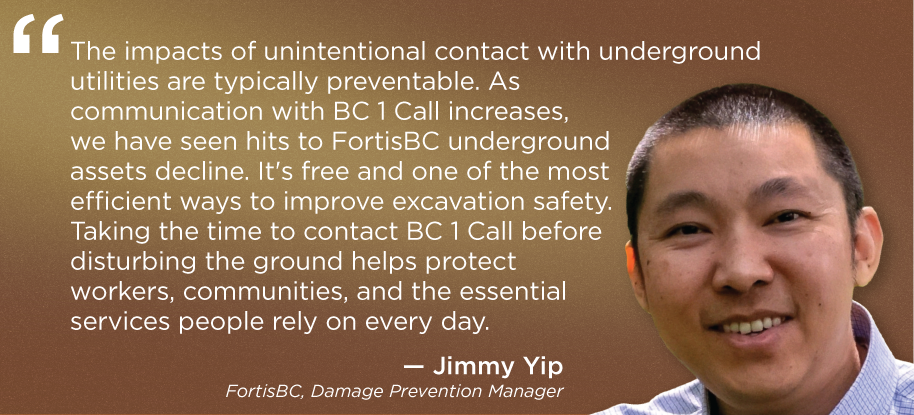
Every utility strike has the potential to trigger a chain reaction that extends far beyond the excavation site.
The immediate priority becomes protecting people. Affected areas must be secured while utilities are isolated, often resulting in evacuations. While evacuation of a business is never convenient, the evacuation of a hospital or long-term care home can have much greater implications. Traffic that is already congested may be completely cut off and redirected for hours. For contractors working to demanding schedules, even a brief shutdown can affect budgets, while major incidents may delay work for weeks.
For an uninformed homeowner, a single shovel strike in their garden can trigger neighbourhood gas service interruptions. These interruptions require utility crews to safely restore service and often necessitate the relighting of pilot lights at every affected home —a cost that may ultimately be borne by the person responsible for the damage.
In 2023, the Canadian Common Ground Alliance estimated damage to underground infrastructure cost Canadian society more than $1 billion each year; however, repairs represent only a fraction of that amount. Those costs are ultimately shared by communities, industry and government through project delays, business disruption, environmental remediation, emergency response and lost productivity that often continues long after the damaged utility has been repaired.
The most effective damage prevention measures are not particularly dramatic or expensive.
They are the decisions made during planning meetings, and the BC 1 Call locate requests submitted before work begins. They are the field verifications, which confirm conditions match expectations and that underground assets are properly daylighted. Most important of all, they are the willingness to stop when any of these steps are missed. None of these actions generate headlines. Together, they prevent them.
The damage prevention industry often describes its work as protecting underground infrastructure. While that is certainly true, perhaps the larger responsibility is protecting public confidence. Confidence that a hospital will have power when it is needed, a family can heat their homes in winter and clean drinking water will continue flowing when a tap is opened. Confidence that construction can continue safely in one of the fastest-growing provinces in the country.
Next week in Beneath B.C.
The Five Steps to Underground Safety: Damage prevention doesn’t begin when the shovel hits the ground, and it doesn’t end when utilities are marked. Discover the five essential steps that help keep people safe, projects moving and British Columbia’s underground infrastructure protected.
Donna Grant is president of BC 1 Call. Throughout her career, she has worked at the intersection of infrastructure, construction, public safety, stakeholder collaboration and organizational leadership. Through the Beneath BC series, she explores the opportunities and challenges shaping the future of underground infrastructure in British Columbia. Since 1994, BC 1 Call has connected the excavation community with owners of underground infrastructure before digging begins, helping protect critical infrastructure and promote safer excavation across British Columbia.




Recent Comments
comments for this post are closed